Key Highlights
- Section 138 of the Negotiable Instruments Act, 1881, is the law that makes cheque bounce a criminal offence in India. The remedy is a court complaint within a strict timeline, not just a civil recovery suit.
- The window is unforgiving: a 30-day notice to the drawer must be sent within 30 days of the bank's return memo, and the complaint must be filed within 30 days after the 15-day payment grace period in the notice. Miss any of these windows and the criminal remedy is gone.
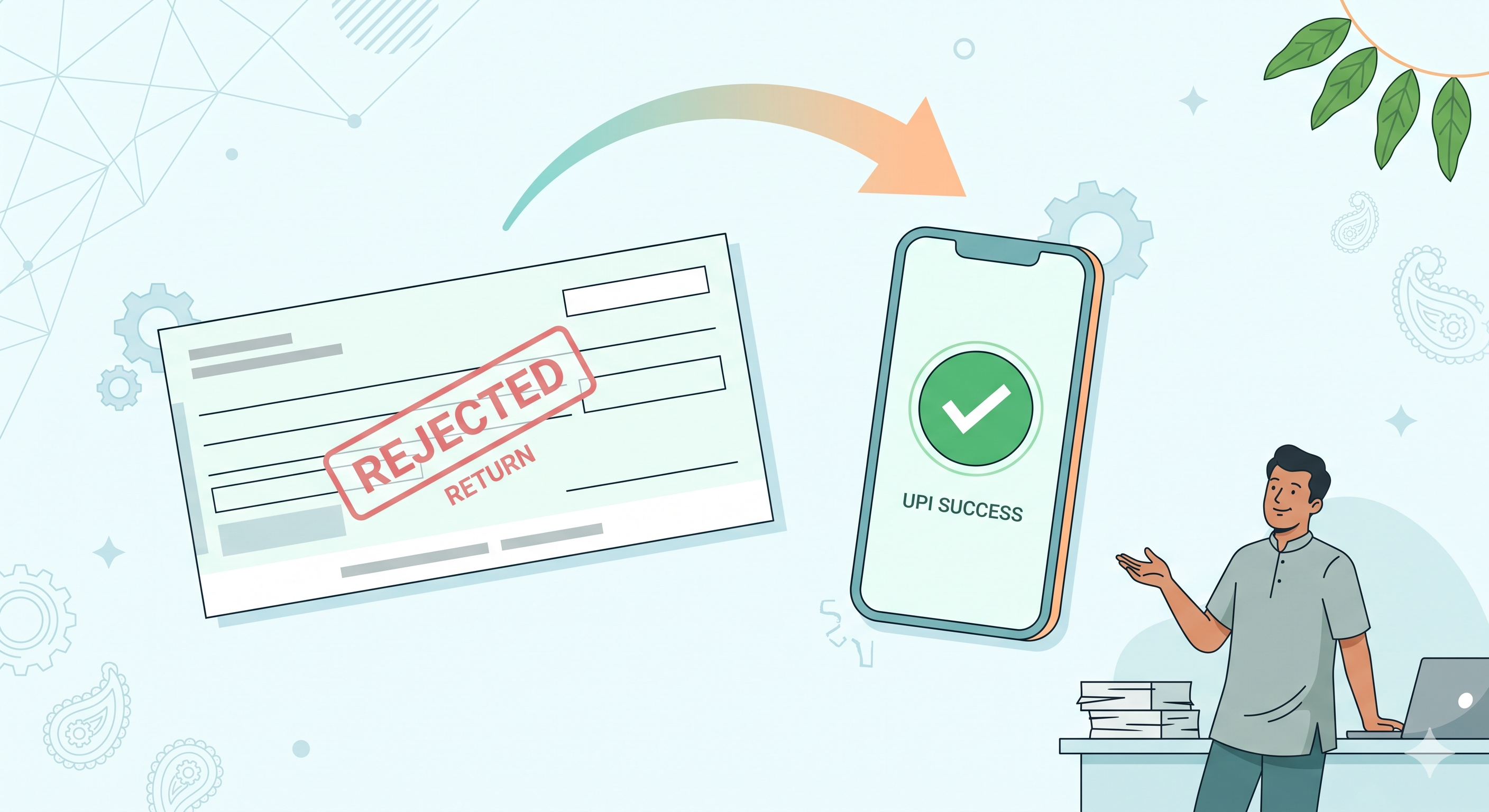
- The best cheque bounce strategy in 2026 is prevention, not recovery. A distributor who has shifted 70% of collections to UPI on payment links has roughly 90% fewer cheque bounce events than one running on cheque-and-deposit-slip.
In This Article
- What actually happens when a cheque bounces
- The Section 138 timeline, day by day
- What the 30-day notice must contain
- The cost-benefit of pursuing legal action
- Civil recovery vs criminal complaint
- How digital collection prevents most cases
- A Lucknow stationery distributor's cheque bounce ledger
- Frequently asked questions
What actually happens when a cheque bounces
You deposit a retailer's cheque for ₹78,000 on a Tuesday. On Friday, your bank returns it with a "cheque return memo" stating the reason. Common return reasons:
- Funds insufficient (most common, around 70% of cases)
- Account closed
- Signature mismatch
- Stop payment instruction by the drawer
- Drawer's signature differs
The bank will normally also charge you a return fee, ₹150 to ₹500 depending on the bank. The cheque amount stays in your books as receivable, plus the bank charge as a small loss.
At this moment, the clock starts. The 30-day window for sending a legal notice begins on the date of the bank's return memo, not the date you deposited the cheque or the date the retailer issued it.
The Section 138 timeline, day by day
Section 138 of the Negotiable Instruments Act creates a criminal offence when a cheque is dishonoured for insufficient funds, on a debt that is "legally enforceable". Punishment can include up to 2 years imprisonment, a fine up to twice the cheque amount, or both. In practice, most cases settle once the criminal complaint is filed, because the drawer wants to avoid a court appearance and the criminal record.
The timeline is rigid. Three windows that must not be missed:
| Stage | Window | Who acts |
|---|---|---|
| 1. Deposit and bounce | Cheque must be deposited within 3 months of issue (validity) | You |
| 2. Send legal notice | Within 30 days of the bank return memo | You, through advocate |
| 3. Drawer's response window | 15 days from receipt of notice to make the payment | Drawer |
| 4. File complaint | Within 30 days after the 15-day window expires | You, in magistrate court |
If you miss any of these, the criminal remedy under Section 138 is gone. You can still pursue a civil suit for recovery of the amount, but the leverage of a criminal complaint, which is what makes most cases settle, is no longer available.
What the 30-day notice must contain
The legal notice must be sent through a registered advocate, by registered post with acknowledgement, to the address of the drawer as recorded on the cheque or the bank account. It must contain:
- The full details of the cheque (number, date, amount, bank, branch)
- The fact that the cheque was presented and returned, with the date of the return memo
- A clear demand for payment of the cheque amount within 15 days of receipt of the notice
- A statement that failure to pay within 15 days will lead to a complaint under Section 138
Get this notice drafted by an advocate. Self-drafted notices often miss technical requirements that the drawer's lawyer will use to get the case dismissed at admission stage. The cost of an advocate-drafted notice is typically ₹2,000 to ₹5,000 depending on city.
The cost-benefit of pursuing legal action
Filing a Section 138 complaint is not a free decision. The realistic costs:
| Cost item | Typical range |
|---|---|
| Advocate's notice (one-time) | ₹2,000 to ₹5,000 |
| Court fee on complaint filing | ₹200 to ₹2,000 depending on amount |
| Advocate's fee for the complaint | ₹15,000 to ₹50,000 depending on city and case |
| Time cost: number of court appearances | 8 to 20 over 1 to 3 years |
For a single bounced cheque under ₹50,000, the math often does not work out unless you have a deeper relationship issue with the retailer. For amounts above ₹2 lakh, or for repeat offenders, it almost always does.
A useful rule of thumb: pursue legal action when (cheque amount + cost of bad debt impact) > 3x (legal cost + your time). For most distributors, that threshold sits around ₹1 lakh to ₹1.5 lakh.
The other reason to pursue is the deterrent effect. Other retailers in the same market quickly learn whether a particular distributor follows through on Section 138. Distributors who file at least one or two cases a year on amounts over ₹1.5 lakh have noticeably fewer cheque bounce events from other parties in the same circle.
Civil recovery vs criminal complaint
A common confusion: Section 138 is a criminal proceeding, not a civil recovery. If you win, the court orders a fine plus possible imprisonment. To actually recover the money, you usually still have to pursue civil execution.
In practice, the criminal complaint is leverage. Once the complaint is admitted and the drawer has to start appearing in court, settlement becomes the easier path for them. The settlement is then drafted as a compounded settlement, the amount is paid directly to the distributor, and the criminal complaint is withdrawn.
For amounts under ₹2 lakh, some distributors prefer to skip Section 138 and file a summary suit under Order 37 CPC for direct recovery. This is faster in some courts (typically 6 to 18 months) but does not carry the criminal threat that motivates settlement. Most experienced advocates in distributor-heavy cities will advise filing both, with the Section 138 complaint as the leverage and the civil recovery as the path to actual money.
How digital collection prevents most cases
The best cheque bounce strategy is to receive far fewer cheques in the first place.
UPI payment links remove the entire failure mode. The retailer either has the money in their account at the moment they tap the link, or they do not. If they do not, the transaction does not complete, and you do not have an open receivable masquerading as a paid one. The cheque bounce risk window, the gap between cheque issue and bank clearing, simply does not exist.
NEFT and RTGS work the same way. Once the money is sent, it is sent. There is no return memo three days later.
Distributors who have shifted 70% or more of their collections to UPI typically report:
- 80 to 95% reduction in cheque bounce incidents
- 4 to 6 day reduction in DSO (because cheque float is gone)
- Significant reduction in accountant time spent on bank reconciliation
- Lower legal costs across the year
The remaining 25 to 30% of collections that still come on cheque is usually concentrated in a few habitual cheque-issuing retailers. For these, the rule of thumb is: do not deposit a cheque you have any doubt about. Either have the retailer pay UPI on the link, or hold the cheque until you have informal confirmation that the funds are in the account.
A Lucknow stationery distributor's cheque bounce ledger
A stationery distributor in Lucknow, ₹9 crore turnover, 110 retail parties. In FY 2024-25, they tracked 23 cheque bounce events, total face value ₹4.7 lakh. Of these, 7 were repeat from the same 3 parties.
Of the 23, the distributor pursued legal action on only 4. The other 19 were either small amounts (under ₹40,000) or settled informally with replacement payment. Of the 4 legal cases, 2 settled within 6 months for the full amount plus interest, 1 settled at 80% of the amount after 14 months, and 1 was still in court at the time of writing this.
In FY 2025-26, after shifting 78% of collections to UPI on payment links, the bounce ledger looked like this:
| Metric | FY 2024-25 | FY 2025-26 (projected) |
|---|---|---|
| Cheque bounce events | 23 | 4 |
| Total bounced face value | ₹4.7 lakh | ₹85,000 |
| Legal cases filed | 4 | 1 |
| Bad debt write-off from bounce events | ₹62,000 | ₹0 (so far) |
The distributor's accountant estimated the time savings on cheque deposit, follow-up, and reconciliation at roughly 4 hours a week.
What Takkada is, in one sentence
Takkada puts a UPI payment link on every Tally invoice and reconciles the receipt back into Tally instantly, so distributors collect the cash up front and avoid the cheque bounce, deposit slip, and Section 138 cycle altogether.
Frequently Asked Questions
Q: How long do I have to file a Section 138 complaint?
A: The full sequence: cheque must be presented within 3 months of issue. Notice must be sent within 30 days of the bank return memo. The drawer has 15 days from notice receipt to pay. The complaint must be filed within 30 days after the 15-day window ends. Missing any of these windows extinguishes the criminal remedy, though civil recovery remains available.
Q: Can I deposit a bounced cheque again?
A: Yes. A cheque can be presented multiple times within its 3-month validity. Many distributors present a bounced cheque a second time after informally confirming with the drawer that funds are now in the account. Each presentation that bounces resets the 30-day notice window, but only one Section 138 complaint can be filed per cheque presentation cycle.
Q: Is the cost of Section 138 worth it for a ₹40,000 cheque?
A: Usually not, on direct economics. Legal costs and time will eat much of the recovery. The exception is when the retailer is a repeat offender with multiple bounces; in that case the deterrent value across your other receivables can justify the cost even on a smaller individual amount.
Q: What if the retailer pays after I have already sent the legal notice?
A: If they pay the full cheque amount within the 15-day window, no complaint can be filed under Section 138. If they pay after the 15-day window but before you file the complaint, you can choose to accept the payment and not file. Most distributors in this situation accept the payment, send a written acknowledgement, and move the relationship to advance-payment terms.
Q: Will a Section 138 case actually recover my money?
A: A Section 138 conviction by itself does not transfer money to you. It results in a fine and possible imprisonment. The recovery happens through settlement, which is what most cases lead to. The threat of criminal record motivates settlement; the actual money comes from the drawer paying you to withdraw the complaint.
Internal Links
- Outstanding Payment Reminder: How the Best Distributors Run It in 2026
- Payment Link Tally Integration: How Distributors Collect Without the 9 PM Reconciliation
- Udhar Vasuli Kaise Kare: A Working Playbook for Indian Distributors in 2026
Takkada helps Indian distributors using Tally collect payments, send WhatsApp reminders, and generate e-invoices, all from mobile. Book a free demo.
This article is for general information only and does not constitute legal advice. For any specific cheque bounce or Section 138 matter, consult a qualified advocate in your jurisdiction.