Key Highlights
- DSO equals total receivables divided by revenue, multiplied by the number of days in the period. For most Indian FMCG and B2B distributors a healthy DSO sits between 45 and 65 days.
- A DSO over 75 days usually means three things have stacked up: stretched credit terms, slow reminder cadence, and reconciliation that runs days behind the bank.
- Pulling DSO down by even 10 days releases roughly 2 to 3 weeks of working capital. On a ₹15 crore turnover, that is ₹40 to ₹50 lakh sitting back in your current account instead of in retailer ledgers.
In This Article
- What DSO actually measures
- The DSO formula, with a worked example
- What a healthy DSO looks like for an Indian distributor
- Why your DSO creeps up over time
- Five levers to bring it down
- A Pune FMCG distributor's 18-day DSO drop
- Frequently asked questions
What DSO actually measures
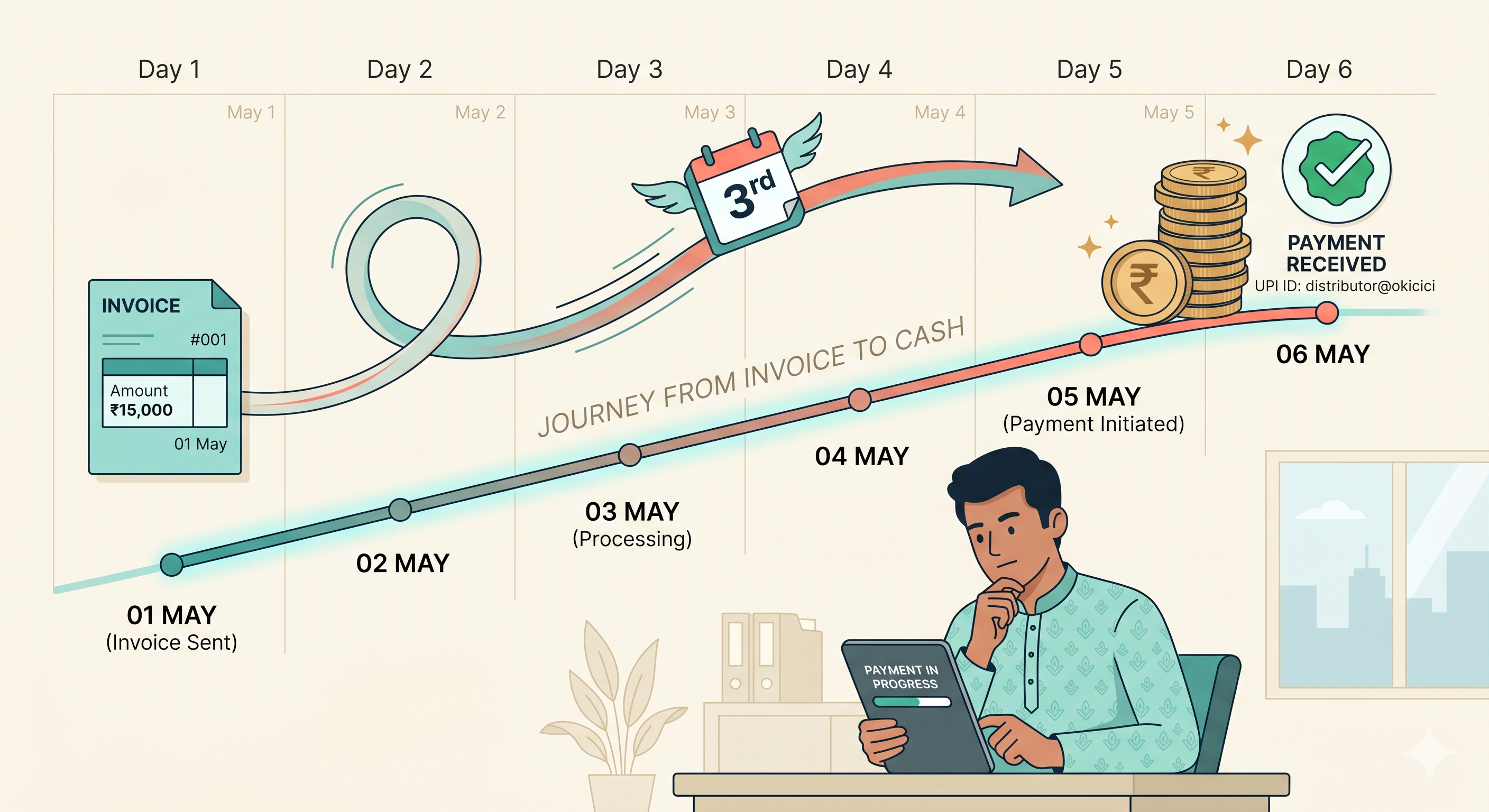
DSO is one number that captures how long, on average, your money sits in someone else's bank account before it lands in yours. If you raise an invoice on 1 April and the customer pays on 15 May, that invoice has a DSO of 44. Average that across every invoice, weighted by value, and you get the headline DSO for the business.
The reason it matters more than "total receivables" is comparability. A distributor with ₹3 crore in receivables on ₹20 crore turnover is in a very different place from one with ₹3 crore on ₹8 crore turnover. The first has a DSO of around 55, the second around 137. Same outstanding amount, completely different health.
The DSO formula, with a worked example
The standard formula:
DSO = (Total Accounts Receivable / Total Credit Sales) × Number of Days in Period
Take a Hyderabad pharma distributor with these numbers for the quarter ending March 2026:
| Line item | Amount |
|---|---|
| Credit sales for the quarter (Jan to Mar) | ₹6.20 crore |
| Receivables on 31 March | ₹3.85 crore |
| Days in the period | 90 |
DSO = (3.85 / 6.20) × 90 = 55.8 days
So this distributor is collecting, on average, around 56 days after the invoice is raised. If their stated credit terms are 30 days, they are running 26 days behind their own policy. That is the gap that costs working capital.
A monthly view works the same way. Use 30 or 31 days, the receivables on the last day of the month, and the credit sales for that month.
What a healthy DSO looks like for an Indian distributor
There is no single right answer because credit terms vary by category. Rough benchmarks for distributors in 2026:
| Category | Typical credit terms | Healthy DSO range |
|---|---|---|
| FMCG, daily-movement goods | 7 to 21 days | 25 to 40 days |
| FMCG, slow-moving SKUs | 30 days | 40 to 55 days |
| Pharma | 30 to 45 days | 45 to 60 days |
| Electronics, appliances | 30 to 60 days | 55 to 75 days |
| Industrial, B2B specialty | 45 to 90 days | 70 to 100 days |
If your DSO sits within these ranges, you are running the operation roughly in line with your category. Above the upper end, your cash is leaking out faster than the business can replace it.
Why your DSO creeps up over time
Almost every distributor watches DSO drift upward over a five-year window. The drift comes from three places.
Sales team incentives, first. Salesmen are usually paid on volume, not collections. Extending an extra 15 days of credit to land a new retailer feels free at the point of sale. It is not. It adds straight to DSO.
Customer concentration, second. As you grow, two or three large parties become 30 to 40% of your book. They negotiate longer terms because they can. Your headline DSO drifts toward whatever they pay at, regardless of the policy on paper.
Reminder lag, third. The accountant who chased payments at day 30 in 2019 is now chasing 200 invoices a month and only getting to half of them. Reminders that should fire on day 15 fire on day 28. Reminders that should fire on day 30 fire on day 45. The cadence slips, and DSO follows.
Five levers to bring DSO down
Each lever moves DSO by a different amount. Stack them and a 70-day DSO can become 50 in a quarter.
Lever 1: Tighten the cadence at the front, not the back. Most distributors react. They start chasing on day 30, when the invoice is already late. Move the first reminder to day 0, the day of dispatch. The invoice arrives on the retailer's phone with a payment link. A meaningful slice, often 8 to 12% of receivable value, is paid the same week. Front-loading the cadence pulls 5 to 7 days off DSO without any extra effort.
Lever 2: Put a UPI link on every invoice. A retailer who has to reach for a chequebook, fill it in, find someone to deposit it, and wait for it to clear, will pay later than one who taps a link in WhatsApp. Even a 20% shift from cheque to UPI moves DSO by 4 to 6 days because the float between cheque issue and clearing disappears.
Lever 3: Reconcile in real time. Reminders that keep going to retailers who already paid destroy the whole exercise. The accountant looks unprofessional, the retailer feels disrespected, and the next time you genuinely need a reminder it gets ignored. Match payments to invoices as they arrive, not at end of week.
Lever 4: Cap credit on the parties driving DSO upward. Pull a 90-day aging report. Identify the five parties contributing the most overdue value. Set a hold-on-dispatch rule for new invoices when their bucket crosses a threshold. Two or three of them will start paying faster within the month. The others, you take a call on whether the relationship is worth it.
Lever 5: Use credit notes correctly. Disputes that sit unresolved for 60 days inflate DSO. If a retailer has a genuine claim for ₹3,200 against an invoice of ₹18,340, raise the credit note for ₹3,200 and chase the ₹15,140 that is undisputed. Most accountants leave the whole invoice open until the dispute is settled. That is 60 days of avoidable DSO.
DSO vs the cash conversion cycle
DSO is one piece of a bigger number. The cash conversion cycle (CCC) is:
CCC = DSO + DIO (Days Inventory Outstanding) - DPO (Days Payable Outstanding)
For a distributor on 30-day supplier credit, with 25 days of inventory on hand and 60 days of DSO, CCC = 60 + 25 - 30 = 55 days. That is how long working capital is locked between paying suppliers and getting paid by retailers. DSO is usually the largest and most controllable piece of this, which is why most distributors focus there first.
A Pune FMCG distributor's 18-day DSO drop
A family-run FMCG distributor in Pune, ₹22 crore turnover, 145 retail parties. Headline DSO at 71 days at the start of January 2026.
Three changes over 90 days. First, every Tally invoice was wired to fire on WhatsApp the moment it was created, with a UPI link. Second, the reminder cadence moved from "we call when we remember" to a structured 0, 3, 15, 30, 45 day schedule. Third, payments matched back to invoices within minutes, not at end of day.
By end of March, DSO had fallen to 53. That is 18 days off. On a ₹22 crore turnover, that translates to roughly ₹1.08 crore of working capital released back into the business. The owner used part of it to take 30-day early-payment discounts from two of his suppliers, which added another 1.2% to gross margin.
No staff added. No customer lost. Same sales team, same prices, same product mix.
What Takkada is, in one sentence
Takkada wires every Tally invoice to fire on WhatsApp with a UPI link, runs a structured reminder cadence behind it, and reconciles payments back into Tally in real time, so distributors can pull DSO down without hiring a collections team.
Frequently Asked Questions
Q: What is a good DSO for an Indian distributor?
A: For most FMCG and B2B distributors, anywhere between 45 and 65 days is healthy. The right number depends on your stated credit terms. If your terms are net 30, a DSO of 45 means you are collecting 15 days late on average, which is normal. A DSO above 75 usually points to a structural problem, not just a few slow payers.
Q: Should I use credit sales or total sales in the DSO formula?
A: Credit sales, always. Cash sales should not be in the numerator or denominator because they have a DSO of zero. If your accounting system does not separate the two cleanly, run the calculation only on B2B invoices and exclude any over-the-counter cash collections.
Q: How often should I track DSO?
A: Monthly is enough for most distributors. Track it on a rolling 90-day basis to smooth out month-end timing effects. Tracking weekly tends to add noise without adding signal.
Q: Does extending credit to win new customers always raise DSO?
A: Yes, mathematically it has to in the short term. The question is whether the new customer pays at the rate you priced in. Track new-customer DSO separately for the first six months. If a new party drifts past your stated terms in month one, raise the issue then, not at month four when ₹2 lakh is sitting open.
Q: Can I improve DSO without upsetting customers?
A: Yes. The single biggest source of slow payment is friction, not unwillingness. Most retailers will pay faster if the invoice arrives on their phone, the payment link is one tap, and the reminder is specific to that invoice. Hostile cadences hurt the relationship. Frictionless cadences usually improve it.
Internal Links
- Outstanding Payment Reminder: How the Best Distributors Run It in 2026
- Payment Link Tally Integration: How Distributors Collect Without the 9 PM Reconciliation
- The Working Capital Problem for Indian Wholesalers in 2026
Takkada helps Indian distributors using Tally collect payments, send WhatsApp reminders, and generate e-invoices, all from mobile. Book a free demo.