Key Highlights
- The 2024 D&B India B2B Payment Behaviour report found that 50% of Indian businesses reported worsening B2B payment behaviour; an outstanding payment reminder app is now operational, not optional
- A reminder that lists all outstanding invoices across a party — the "statement blast" — gets ignored; a reminder on one specific invoice with a UPI payment link gets paid
- The strongest lever on outstandings is not the reminder itself; it is pulling the reminder back the moment the invoice is paid
In This Article
- What an outstanding payment reminder app actually is
- Three common mistakes distributors make
- The four-part reminder architecture
- A capability checklist
- An Indore distributor's before-and-after
What an outstanding payment reminder app actually is
An outstanding payment reminder app is a software layer that tracks every open invoice across every party, sends structured reminders at the right intervals, pauses those reminders automatically when the invoice is paid, and keeps the reconciliation back to Tally or another ledger system in real time.
The category started in India around 2017 with products like Vasooli and Udhar Khata, which were effectively digital bahi khatas with reminder buttons. What they lacked was the back-end: no Tally integration, no UTR matching, no auto-pause on payment. So reminders kept going out to parties who had paid, and the distributor had to manually update each ledger entry.
The 2026 shape is different. An outstanding payment reminder app India worth its pricing has four pieces working together: invoice capture, reminder cadence, payment link, and reconciliation. Any three of them without the fourth is a half-solution.
Three common mistakes distributors make
Mistake 1: Sending full outstanding statements as the reminder.
A distributor sends a retailer their full ledger statement showing ₹2,38,450 outstanding across 11 invoices. The retailer looks at the number, feels overwhelmed, and puts the phone down. A reminder on one ₹18,340 invoice with a UPI link asking to clear that one bill works 3 to 5 times better. Statement blasts belong once a month at most, as a summary — never as a reminder.
Mistake 2: Running the cadence off a paid-invoice list.
The accountant updates Tally nightly. The reminder tool reads Tally once in the morning. The retailer pays at 4 PM, and the next morning's reminder goes out as if they had not paid. The fix is live reconciliation — the reminder system must know within minutes that an invoice is paid, not wait for an overnight Tally sync.
Mistake 3: Using the same tone at day 3 and day 45.
A generic "please clear your dues" at every stage makes the retailer stop reading any of them. Tone must escalate from warm (day 0) to neutral (day 15) to firm (day 30) to owner-escalation (day 45).
The four-part reminder architecture
| Component | What it does | Why it matters |
|---|---|---|
| Invoice capture | Pulls every open invoice from Tally or your billing system, with due date, amount, party | The cadence runs per invoice, not per party |
| Cadence engine | Schedules Stage 1–5 reminders based on invoice age and payment status | Age-based tone gets results; same-message repetition does not |
| Payment link | UPI link on every reminder with the exact amount and invoice reference | One-tap payment is the only CTA that moves the metric |
| Reconciliation | Matches incoming UTR to the invoice, auto-pauses the cadence, posts receipt to Tally | Paid parties stop getting reminded; receipt voucher posts without human step |
Take out any one and the system breaks. No invoice capture means the app does not know what to remind about. No cadence means the messages go out as a broadcast. No payment link means the retailer has to dig out your account number. No reconciliation means you chase paid parties and look stupid.
A capability checklist
Score any outstanding payment reminder app against these eight items. Rate each Yes / Partial / No.
Reads open invoices directly from Tally (or your billing system), no CSV upload
Sends reminders per invoice, not per party statement
Five-stage cadence with age-based escalation and different tone per stage
Templates support Hindi, English, and at least one regional language (Bengali, Tamil, Marathi)
UPI payment link pre-filled with amount and invoice reference
UTR-to-invoice auto-matching including split payments
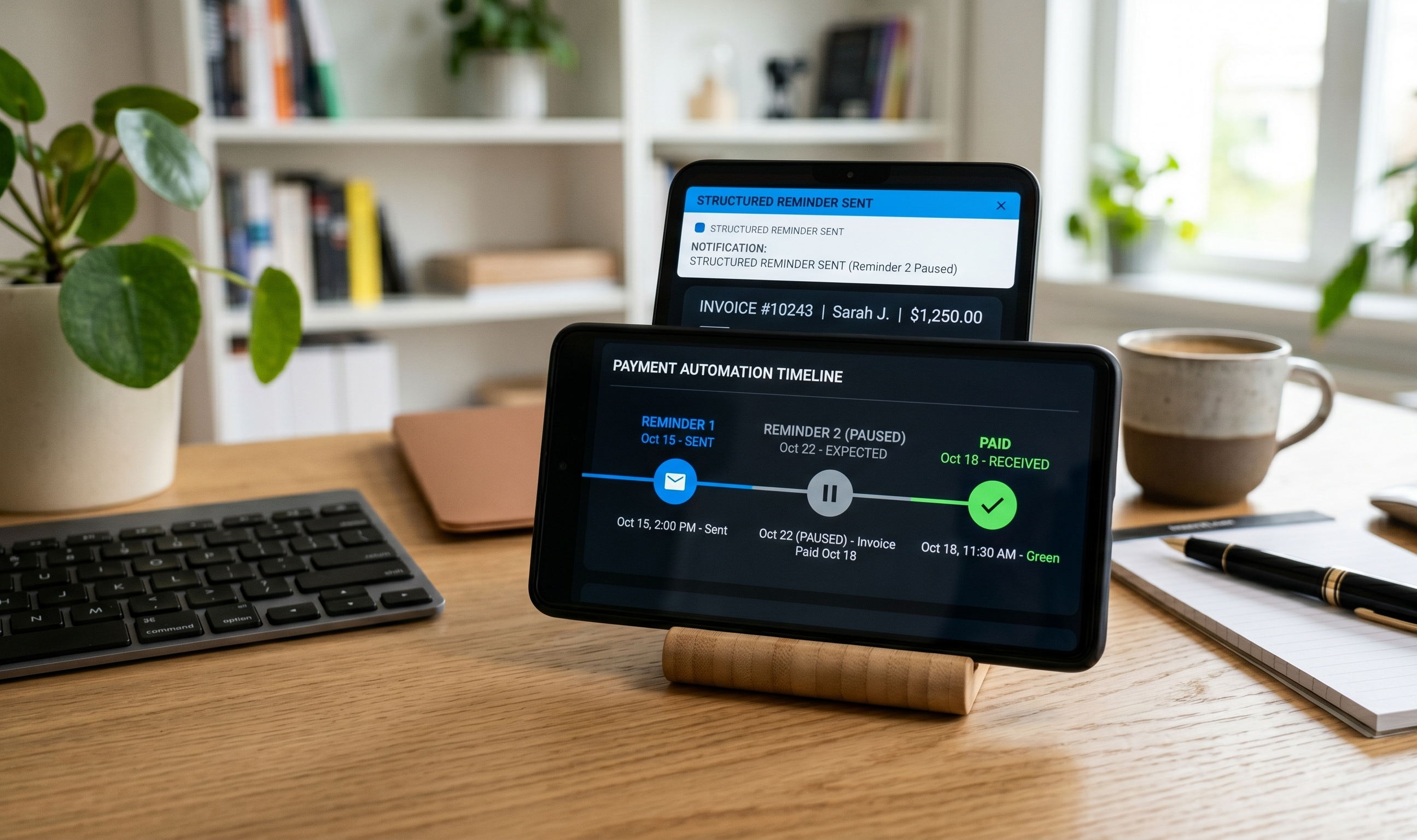
Reminders auto-pause the moment an invoice is paid
Receipt voucher posts back into Tally without human step
Below 6 of 8, the tool is a reminder sender, not an outstanding management system.
An Indore distributor's before-and-after
An Indore dairy distributor, ₹8 crore turnover, 65 retail parties, DSO of 58 days. The accountant was sending WhatsApp messages manually at the end of each day, working from a printed outstanding list. Two people on the chase. Collections were slipping by ₹50,000 to ₹80,000 a week into the next month.
The rebuild took six weeks. Invoice capture through Tally XML integration, five-stage cadence on every open invoice, UPI link on every reminder, UTR reconciliation posting back into Tally nightly.
After eight weeks: DSO at 44 days. One accountant back on GST and margin work. The "chase" part of the week disappeared because the app was doing it, and the retailers were paying faster because the link was right there in the reminder.
The app cost ₹7,500 per user per year. The working capital freed by the 14-day DSO compression was approximately ₹31 lakh — roughly 400 times the app cost, in the first year.
What Takkada is, in one sentence
Takkada is an outstanding payment reminder app for Indian distributors using Tally — five-stage reminder cadence, UPI payment link on every reminder, UTR-to-invoice auto-reconciliation, and receipt vouchers posting back into Tally automatically.
Frequently Asked Questions
Q: Can an outstanding payment reminder app send reminders from my own WhatsApp number?
A: Yes, through the WhatsApp Business API. The API requires a dedicated business phone number (not your personal WhatsApp) but allows template-based automated sends. Most reminder apps handle the API setup for you.
Q: Is the reminder text legally safe in India?
A: As long as the messages are factual — invoice number, amount, due date, payment link — they fall well inside what is allowed. Problems arise when reminders threaten consequences that the distributor cannot legally enforce, or when they impersonate a legal authority. Keep the language factual.
Q: What happens if a retailer disputes an invoice mid-cadence?
A: Tag the invoice as under dispute. A good reminder app pauses the cadence on that invoice automatically and waits for a dispute-resolved flag before resuming.
Q: Does a reminder app help if my credit terms are 90 days?
A: Yes, and arguably more. Longer credit terms mean more outstanding invoices in flight at any time, and more risk of reminders slipping through the cracks. A 90-day cadence just extends the intervals; the principle is the same.
Q: Will retailers respond better to reminders in their local language?
A: Based on customer conversations in Tier 2 and Tier 3 cities, yes. Bengali, Assamese, Tamil, Marathi, Gujarati reminders get roughly 20 to 40% higher response rates than English ones for non-metro retailers. Use the language the retailer already speaks with you.
Internal Links
- WhatsApp Payment Reminder for Distributors: A Cadence That Actually Collects
- Payment Collection App for Distributors India: The 2026 Reality
- Udhar Vasuli Kaise Kare: A Working Playbook for 2026
Takkada helps Indian distributors using Tally collect payments, send WhatsApp reminders, and auto-reconcile receipts, all from mobile. Book a free demo.