Key Highlights
- 50% of Indian businesses reported worsening B2B payment behaviour in 2024; udhar vasuli is getting harder, not easier
- The fundamental trap is giving 60 days of credit while paying suppliers in 30 days; every distributor feels this math, and few fix it systematically
- A proper udhar vasuli playbook has four layers: credit policy, reminder cadence, payment path, and hold-dispatch consequences
In This Article
- Why udhar vasuli is harder in 2026
- The four-layer playbook
- Credit policy: who gets credit, and how much
- Cadence and the payment path
- Chronic late payers: when to stop selling
Why udhar vasuli is harder in 2026
Three things have made vasuli harder than it was five years ago.
First, retailers now juggle more distributors. The average kirana or wholesale buyer buys from 7 to 12 distributors across categories, each extending 30 to 60 days of credit. Your invoice is one of dozens competing for the retailer's attention at month-end.
Second, B2B platforms like Udaan, Jiomart Partner, and quick-commerce wholesale apps have compressed margins. Retailers know they have alternatives to your line, which reduces their urgency to pay promptly. Payment patterns have slipped.
Third, cash has shrunk. UPI has solved some collection friction but introduced reconciliation friction. The accountant who used to count cash at end-of-day now sits with a bank statement, matching 40 to 80 UTRs back to invoices manually.
The net effect: margins of 3 to 5% are now squeezed by longer DSO and higher working capital cost. Udhar vasuli is existential, not an inconvenience.
The four-layer playbook
| Layer | What it covers | Who runs it |
|---|---|---|
| 1. Credit policy | Who gets credit, how much, how long | Owner |
| 2. Reminder cadence | Structured WhatsApp reminders per invoice | App + accountant |
| 3. Payment path | UPI link on every invoice and reminder | App |
| 4. Hold-dispatch consequences | What happens when a party crosses 45 or 60 days | Owner + godown |
All four must be running. Most distributors have two or three. The missing one is usually layer 1 (credit policy) or layer 4 (consequences).
Layer 1: Credit policy. Who gets credit, and how much
A proper credit policy answers three questions per party, once, and writes them down:
Credit limit. Maximum outstanding at any time. Based on two to three months of historical purchase volume, not the retailer's request.
Credit period. 15, 30, 45, 60 days. Tied to the distributor-supplier term in the same category.
Collection priority. Gold / Silver / Bronze, or tier by value. High-value parties get a call from the owner if they slip; low-value parties get the cadence and no more.
A Guwahati stationery distributor, ₹6 crore turnover, 85 parties, introduced this one table in 2024. No app, no automation — just the table. In six months, DSO came down from 64 to 52 days purely from being clear about who got credit and how much.
Layer 2: Cadence. Structured WhatsApp reminders per invoice
Five stages over 45 days. Covered in detail in our WhatsApp reminder cadence article.
Day 0: invoice dispatch
Day 3: gentle reminder
Day 15: due-date notice
Day 30: firm reminder
Day 45: owner escalation
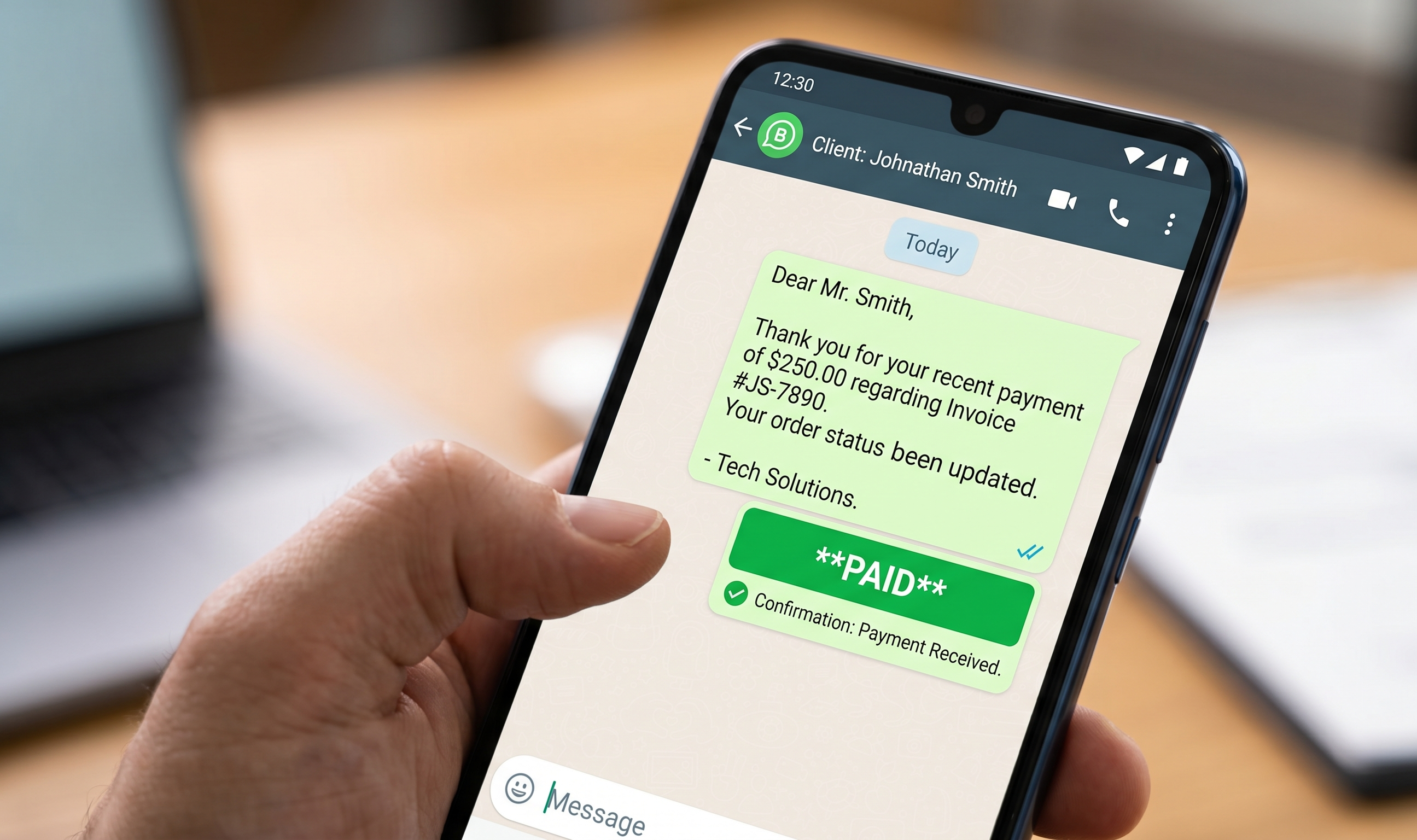
Each message references the specific invoice and amount. None of them is a statement blast. All of them carry a UPI payment link. The cadence pauses the moment the invoice is paid.
Layer 3: Payment path. UPI link on every invoice and every reminder
UPI has changed B2B vasuli permanently. A payment link that opens in PhonePe, Google Pay or Paytm gets paid 3 to 5 times faster than a bank account number printed at the bottom of the PDF. The math is behavioural: for a retailer, tapping a link takes two seconds; re-entering IFSC codes takes five minutes.
A good payment link system does four things beyond just sending the link:
Embeds a reference in the link that ties the payment back to the specific invoice
Watches the distributor's bank account for incoming UTRs tagged with that reference
Auto-matches and posts a receipt voucher in Tally against the invoice
Auto-pauses the reminder cadence on that invoice
This is the Tally integration layer. Without it, the app is a messaging app with a payment button.
Layer 4: Hold-dispatch consequences. When a party crosses the line
A cadence without consequences is a polite request. Retailers learn which distributors are strict and which can be ignored.
The playbook:
Day 30 firm reminder explicitly states: "next dispatch hold hoga agar 7 din mein clear nahin hua"
Day 45 owner escalation says the consequence is now active
Day 60 dispatch is actually held until clearance
This is the hard part for most family-run distributors. Relationships are long, retailers push back, and the owner usually backs down. But the ones who do hold dispatches consistently run the healthiest receivables books. A Surat textiles distributor we know holds two to three parties per month on this rule and still grew 18% year-on-year — because the retailers who valued the relationship paid to keep the supply flowing.
When a party becomes chronic
If a party is at day 60+ and ignoring the cadence, three options:
Switch to cash-and-carry. No more credit. Goods move only on UPI upfront. Owner conversation, not accountant.
Negotiate a repayment plan. Agreed weekly tranches via UPI, tracked as receipts against the oldest invoice first. Written on WhatsApp so both sides have a record.
Stop selling. Painful. Sometimes right. Typical distributor has 2 to 4 parties a year that end up here. Better to lose the sale than carry a ₹3 to 5 lakh bad debt on 3% margins.
What Takkada is, in one sentence
Takkada gives Indian distributors the full udhar vasuli stack on mobile — five-stage WhatsApp reminders, UPI payment link on every invoice, live reconciliation into Tally, and a dashboard that tells the owner which parties to hold before the next dispatch.
Frequently Asked Questions
Q: Is udhar vasuli through WhatsApp legal in India?
A: Yes. Commercial reminders about your own invoices are fully permitted as long as they are factual and non-coercive. Problems arise only when messages threaten consequences that the distributor cannot legally enforce.
Q: Kya udhar vasuli ke liye lawyer hire karna padega?
A: Rare for distributor-scale outstandings. Lawyers enter only when a single party owes more than ₹2 to 3 lakh and is openly refusing to pay. For the normal cadence at ₹20,000 to ₹1 lakh per invoice, WhatsApp + phone + dispatch hold does 95% of the work.
Q: What is the best language for vasuli messages in Tier 2 cities?
A: The language the retailer already speaks with you. Hinglish works in most of North and Central India. Bengali, Assamese, Tamil, Marathi, Gujarati in their respective states. Do not shift to formal English for reminders — it feels like a bank recovery notice and gets ignored.
Q: Should I offer a small discount for early payment?
A: A 1 to 2% early-payment discount for clearance within 10 days can work, but measure the lift first. For a ₹5 crore distributor, a 2% discount on even 40% of invoices is ₹4 lakh a year — only worth it if DSO actually compresses by 8 to 10 days as a result.
Q: How do I handle advances from big parties?
A: Log them as advance receipts on the party's ledger in Tally, and auto-apply against invoices as they get raised. A good payment app does this automatically. Without it, your outstanding report lies — a party with ₹2 lakh in advance is shown as debtor, not creditor.
Internal Links
- WhatsApp Payment Reminder for Distributors: A Cadence That Actually Collects
- Outstanding Payment Reminder App India: What Works in 2026
- The Working Capital Problem for Indian Wholesalers in 2026
Takkada helps Indian distributors run udhar vasuli the structured way — WhatsApp reminders, UPI payment links, and live reconciliation into Tally, all from mobile. Book a free demo.