Key Highlights
- An average Indian distributor's accountant spends 3 to 5 hours a day on phone calls and WhatsApp chasing receivables
- Generic "kindly clear your dues" broadcasts get ignored; a structured WhatsApp payment reminder cadence for distributors tied to invoice age pulls in 30 to 50% more on-time payments
- The single worst reminder mistake is chasing a retailer who already paid, because your reconciliation is behind
In This Article
- Why cold calls and blanket broadcasts have stopped working
- The five-stage WhatsApp reminder cadence
- Template language for each stage (Hindi and English)
- How to not chase paid parties by mistake
- A Barpeta FMCG distributor's reminder week
Why cold calls and blanket broadcasts have stopped working
Pick up your phone, try calling five retailers in Barpeta or Dibrugarh right now and asking for ₹45,000 pending since last month. You will get three voicemails, one "bhaiya, shaam ko" and one who actually picks up. This is the 2026 reality of B2B collections.
Retailers have learned to screen numbers they do not recognise. They have also learned that a voicemail from a distributor's accountant costs nothing to ignore. The cold phone call used to be the workhorse of vasuli; it is now the least-efficient tool in the box.
Blanket WhatsApp broadcasts have gone the same way. "Dear sir, please clear pending dues" sent to 200 parties at once gets zero responses and a handful of blocks. WhatsApp's own spam filters have tightened; too many generic messages and your number enters a soft-flag state where even legitimate customers stop seeing your messages.
The five-stage WhatsApp reminder cadence
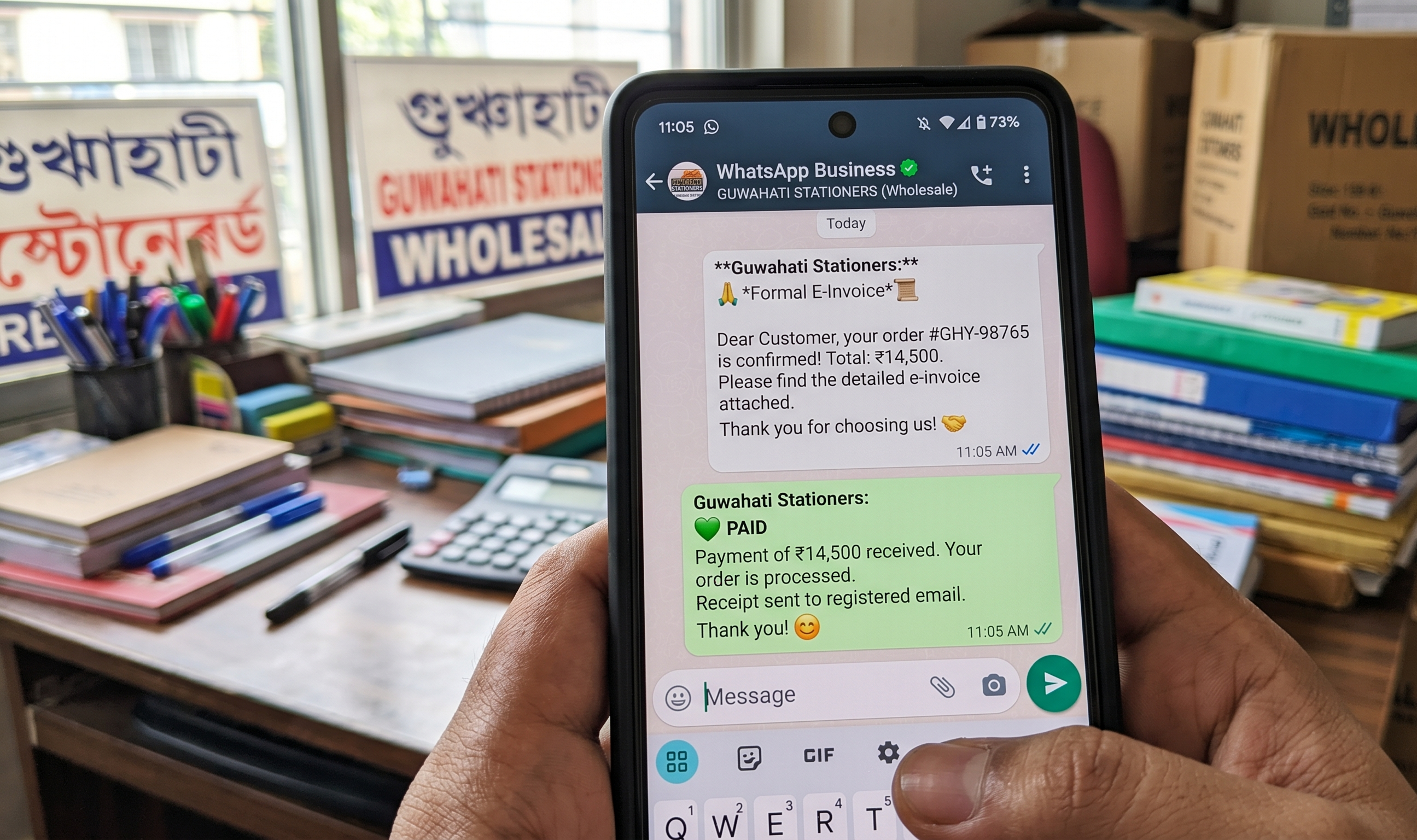
A WhatsApp payment reminder cadence for distributors that works treats each invoice as its own conversation. The messages escalate in tone as the invoice ages, they reference the specific invoice and amount, and they offer a one-tap payment path. This is not a new idea; it is what collections agencies have done for decades. The change in 2026 is that mobile-first tools let a distributor run this at scale without hiring a collections team.
Stage 1: Invoice dispatch (Day 0, at the moment of invoice creation)
A Guwahati stationery wholesaler sends this the moment the sale voucher is saved. The buyer has no reason to ignore it because the goods just arrived.
Template (English):
Hi Rajesh bhai, your invoice INV-2614 for ₹18,340 is attached. Due on 15 June. Pay via UPI: [link]. Any questions, reply here.
Template (Hindi):
Namaste Rajesh bhai, aapka invoice INV-2614 ₹18,340 ka attached hai. Due 15 June ko hai. UPI se pay karne ke liye: [link].
Stage 2: Gentle reminder (Day 3)
Light touch. No pressure. Often the buyer has misplaced the original invoice.
Rajesh bhai, invoice INV-2614 ka reminder. ₹18,340 pending. Payment link: [link]. Koi issue ho to batao.
Stage 3: Due-date notice (Day 15, matching the 15-day net terms most distributors use)
Neutral, factual. Reference the due date so the buyer knows the clock is running.
Invoice INV-2614, ₹18,340, is due today. UPI link to clear now: [link]. Statement aaj shaam tak bhej rahe hain.
Stage 4: Firm reminder (Day 30)
Short, direct, personal. Drop the greeting.
INV-2614, ₹18,340, 30 days overdue. Please clear by end of week. Payment link: [link].
Stage 5: Escalation (Day 45+, owner-to-owner)
This moves out of the accountant's voice into the distributor owner's voice. It is sent once, never twice.
Rajesh bhai, aap se seedha baat. INV-2614 ₹18,340 ab 45 days overdue hai. End of week tak clear kar do, warna next dispatch hold karna padega. UPI link: [link].
Five messages over 45 days, not a single broadcast. Each one is specific to an invoice and offers one-tap payment. Retailers respond because the message is about their own bill, not a form letter.
A cadence summary table
| Stage | Day | Tone | Payment link | When to stop |
|---|---|---|---|---|
| 1. Invoice dispatch | 0 | Warm, informational | Yes | Always send |
| 2. Gentle reminder | +3 | Light | Yes | If invoice paid |
| 3. Due-date notice | +15 | Neutral | Yes | If invoice paid |
| 4. Firm reminder | +30 | Direct | Yes | If paid or under dispute |
| 5. Owner escalation | +45 | Personal, consequences | Yes | After once, call instead |
Template language guidance
Use the retailer's first name plus "bhai" or "ji" based on your normal way of speaking. Copy-paste formality feels like a bank recovery SMS.
Always include the invoice number and amount. Vague reminders ("please clear your dues") get ignored.
Write in the language you already speak to the retailer. Do not shift to English for the reminder when your regular messages are in Hindi, Bengali or Assamese.
Keep payment link the single CTA. No "please contact accounts department" dilution.
How to not chase paid parties by mistake
Nothing destroys goodwill faster than reminding a retailer of a ₹18,340 bill they paid three days ago. They feel disrespected, you look unprofessional, and they make a mental note for the next time they consider switching distributors.
The fix is real-time reconciliation. Your reminder system must know, within minutes, that the invoice is paid. This requires:
Payment link tracking: when a retailer pays through the UPI link, the system knows which invoice got paid
UTR-to-invoice matching: when a retailer pays directly to your bank, the UTR is matched to the correct invoice, usually by amount plus a reference field
Automatic reminder stop: once matched, the system does not send stage 2, 3, 4 or 5 for that invoice
A Dibrugarh FMCG distributor, ₹9 crore turnover, 80 retail parties, estimated based on customer conversations that 1 in 12 reminders they used to send were to parties who had paid. After wiring the reminder system to live reconciliation, that dropped to under 1 in 200. Retailers noticed.
A Barpeta FMCG distributor's reminder week
A family-run FMCG distributor in Barpeta, ₹12 crore turnover, ₹47 lakh in receivables across 120 retail parties. Before: accountant spent 4 hours a day on WhatsApp and phone calls. DSO at 68 days. Roughly ₹8 lakh collected per week.
After setting up the five-stage cadence tied to a payment link and live reconciliation: accountant spends 45 minutes a day on exception cases; the rest is automatic. DSO at 51 days within two months. Roughly ₹11.5 lakh collected per week at the same sales volume.
No aggressive tactics. No collections agent. Just messages sent on the right day, to the right party, about the right invoice, and pulled back the moment the invoice is paid.
What Takkada is, in one sentence
Takkada runs a five-stage WhatsApp payment reminder cadence for Indian distributors, tied to a UPI payment link on every invoice and live reconciliation back into Tally — so retailers get reminded about the bills they actually owe, and the moment they pay, the reminders stop.
Frequently Asked Questions
Q: Does the WhatsApp Business API allow automated payment reminders?
A: Yes, but only through pre-approved templates. You cannot send free-form automated text. The templates you use for stages 1 to 5 need to be submitted for approval once; after that, each send costs roughly ₹0.80 to ₹1.20 per message depending on country and template category.
Q: Won't retailers block us if we send multiple reminders?
A: If the messages are specific (invoice number, amount, payment link) and spaced out across 45 days, blocking is rare. Blanket broadcasts cause blocks; targeted reminders rarely do. If you are getting blocked, check whether your cadence is actually escalating or just repeating.
Q: Can I send reminders in Assamese, Bengali or Tamil?
A: Yes. WhatsApp templates support all major Indian languages. Retailers tend to respond faster to reminders in their own language, especially in Tier 2 and Tier 3 cities.
Q: How many parties can I run this cadence on?
A: There is no hard limit, but WhatsApp Business API pricing scales linearly. A distributor with 150 parties sending 3,000 reminder messages a month pays roughly ₹2,400 to ₹3,600 at ₹0.80 to ₹1.20 per message. Most apps bundle a message allowance in their plan.
Q: Does this work for parties whose invoice is under dispute?
A: Dispute status should pause the cadence. A party pushing back on an invoice needs a human conversation, not a firm reminder at day 30. Tag the invoice as disputed in your app and let the cadence resume only after the dispute is resolved.
Internal Links
- Payment Collection App for Distributors India: The 2026 Reality
- Payment Link Tally Integration: Collect and Auto-Reconcile
- Outstanding Payment Reminder: How the Best Distributors Run It
Takkada helps Indian distributors using Tally collect payments, send WhatsApp reminders, and generate e-invoices, all from mobile. Book a free demo.